skip-to-main-content
The Leadership of Dubai - dda
The Leadership of Dubai
H. H. Sheikh Mohammed bin Rashid Al Maktoum
Birth and early life
H. H. Sheikh Mohammed bin Rashid Al Maktoum was born in 1949 as the third son of Sheikh Rashid bin Saeed Al Maktoum, growing up in the Al Shindagha area of Dubai under the guidance of his parents and his grandfather, Sheikh Saeed, the then Ruler of Dubai.
From an early age, he developed interests in falconry, horse riding, and leadership, often sitting beside his grandfather during daily majlis gatherings that shaped his understanding of governance. He began his education with private tutoring in Arabic and Islamic studies, later attending Al Ahmadiya, Al Shaab, and Dubai Secondary School, completing his studies in 1965.
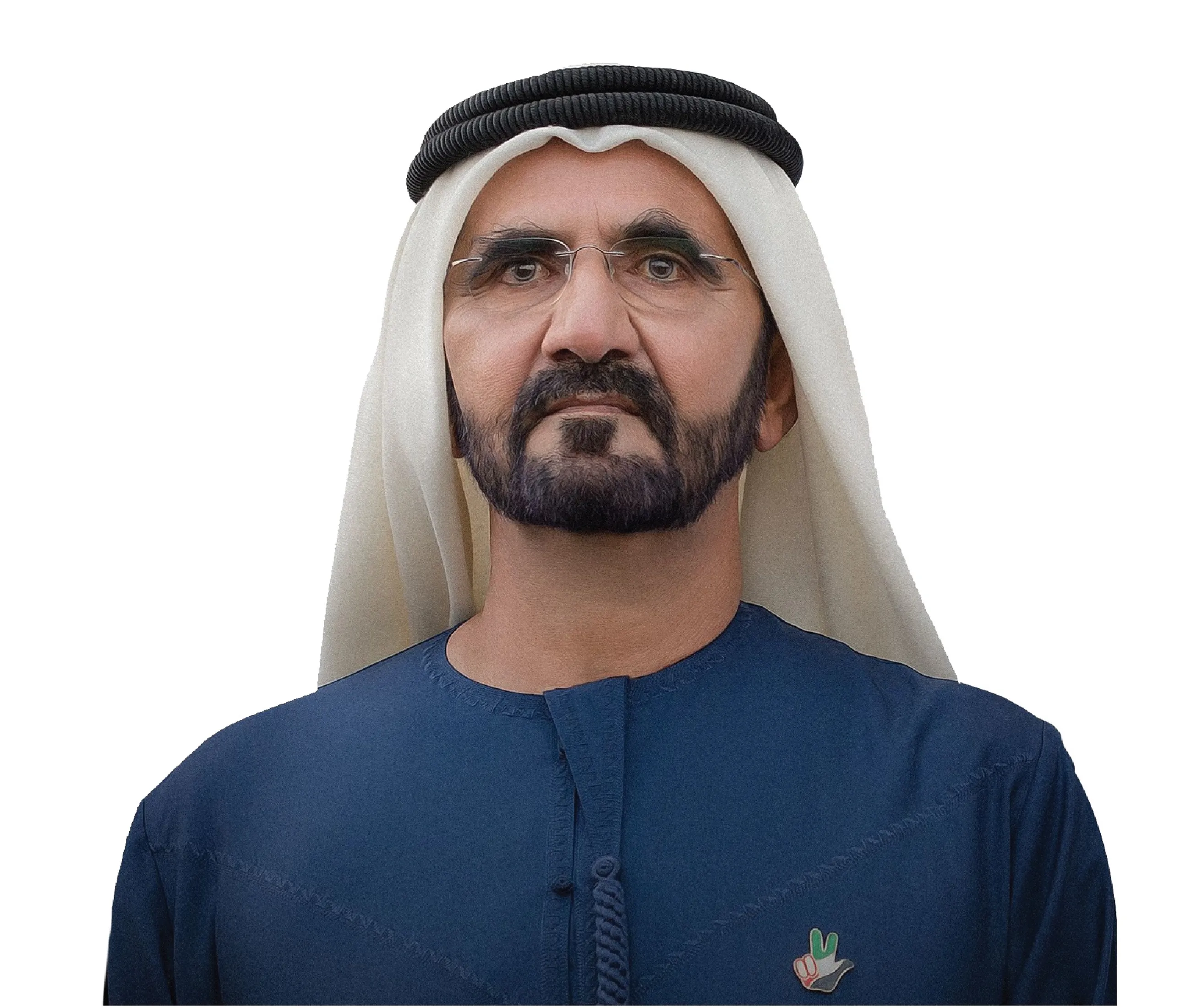
After his grandfather’s passing in 1958, his father prepared him for government responsibilities. To enhance his knowledge, Sheikh Mohammed studied at the Bell School of Languages in Cambridge in 1966 and later trained at the Mons Officer Cadet School in Aldershot, where he excelled and received the Sword of Honor for achieving the highest mark among international cadets — a reflection of his discipline, intellect, and leadership qualities that would later define his rule.
His Public Positions
H. H. Sheikh Mohammed bin Rashid Al Maktoum began his public service in 1968, when his father, Sheikh Rashid bin Saeed Al Maktoum, appointed him as Head of Dubai Police and Public Security, marking his first official position. In 1971, he was appointed Minister of Defense in the UAE’s first federal government cabinet, becoming the world’s youngest defense minister. Later, in 1977, he was appointed head of a committee managing Dubai International Airport, where he played a crucial role in developing Dubai as a global aviation hub and establishing its open skies policy. Sheikh Mohammed also supervised Dubai’s oil portfolio, one of the emirate’s most vital economic sectors, and in 1985 he took charge of the Jebel Ali Free Zone, laying the groundwork for Dubai’s industrial and trade expansion.
On 3 January 1995, Sheikh Mohammed was appointed Crown Prince of Dubai by decree from Sheikh Maktoum bin Rashid Al Maktoum. His leadership vision significantly shaped Dubai’s digital and infrastructure transformation. After his brother passed away on 4 January 2006, he became the Ruler of Dubai, and on 5 January 2006, he was elected Vice-President of the United Arab Emirates. Later, on 11 February 2006, he was formally appointed Prime Minister of the UAE, marking the beginning of his ongoing national leadership.
His Initiatives as a Prime Minister
As Prime Minister of the UAE, His Highness Sheikh Mohammed bin Rashid Al Maktoum has launched a series of visionary initiatives aimed at enhancing government performance, fostering innovation, and ensuring long-term national prosperity. From strategic frameworks such as Vision 2021, the UAE National Agenda, and UAE Centennial 2071, to innovative platforms like the Mohammed Bin Rashid Centre for Government Innovation and Government Accelerators, these initiatives have redefined public administration and service excellence in the UAE.
Prime Minister's Initiatives include:
Foundations
Launched under the vision and leadership of His Highness Sheikh Mohammed bin Rashid Al Maktoum, Vice President and Prime Minister of the UAE and Ruler of Dubai, the following landmark foundations reflect his commitment to humanitarian work, knowledge, innovation, cultural understanding, and sustainable development. The aim of these foundations is to empower individuals and communities locally and globally, fostering education, leadership, entrepreneurship, and social welfare. These initiatives form a comprehensive ecosystem that drives positive change and enhances Dubai’s role as a global hub for development and philanthropy.
Awards
The following prestigious awards celebrate excellence, innovation, and humanitarian achievement across diverse fields including religion, culture, education, media, business, and government. They aim to inspire creativity, promote tolerance and knowledge, and recognize individuals and institutions that contribute to the progress of Dubai, the UAE, and the wider humanity.
His Poetry
H.H. Sheikh Mohammed bin Rashid Al Maktoum began composing Nabati poetry during his school years, deeply inspired by his father, the late Sheikh Rashid bin Saeed Al Maktoum, and the late Sheikh Zayed bin Sultan Al Nahyan. He published his first poems under pseudonyms such as Nedawi and Saleet to ensure his work was appreciated on merit not because he is a member of the ruling family. Today, he is recognized as one of the leading poets of Nabati verse, with his English collection “Poems from the Desert” achieving best-seller status.
Was this content helpful